Cuisine & Culture
Teppanyaki vs. Hibachi: Why the Difference Matters (and Why One Isn't Really Japanese)
April 27, 2026 · 8 min read
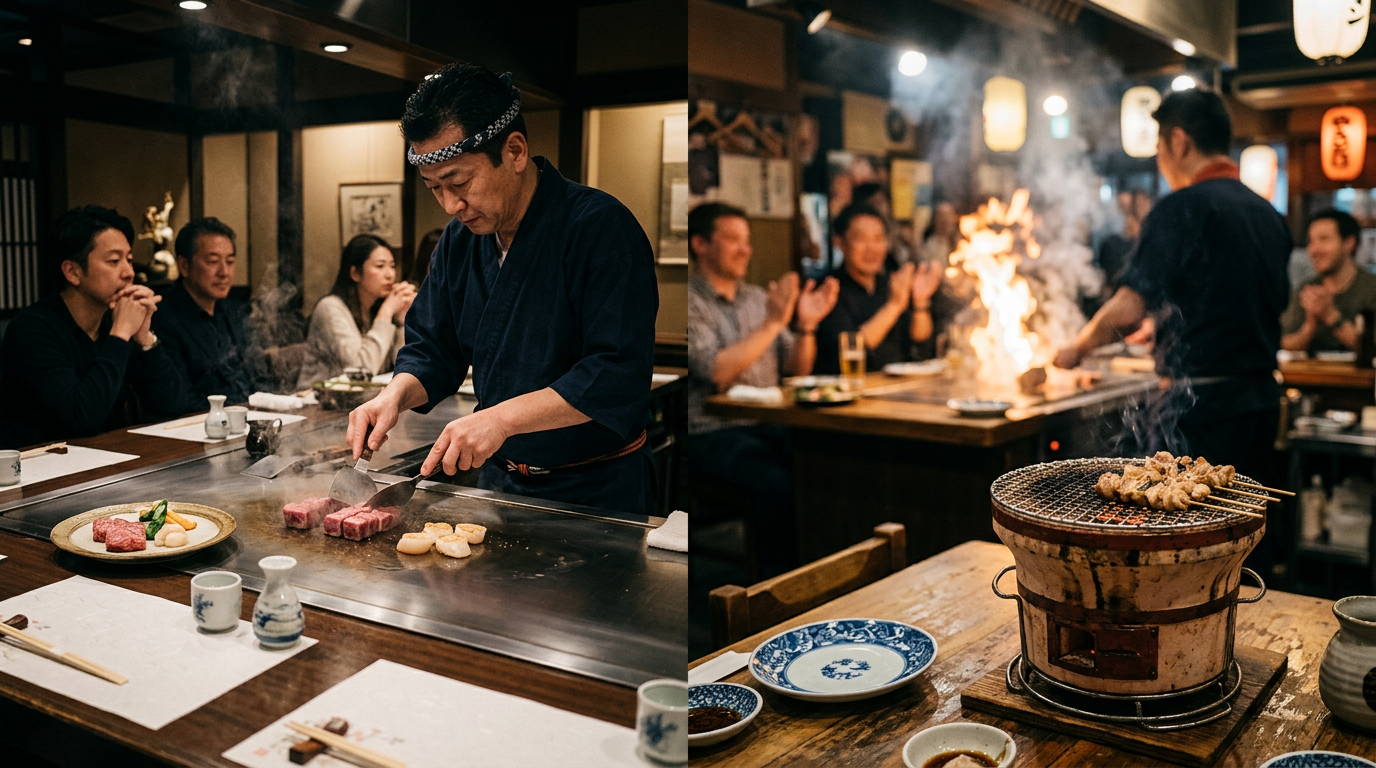
If you have eaten at a restaurant where a chef stood behind a large iron griddle, cracked jokes, spun a salt shaker across his knuckles, and tossed a piece of shrimp toward your mouth, you have not eaten hibachi. You have eaten teppanyaki — or more precisely, an American entertainment concept loosely based on it.
This is not a trivial correction. The conflation of these two terms has, over several decades, produced a situation where a Japanese-American theatrical format has so thoroughly colonized the English-language name of a Japanese culinary tradition that many people have never encountered the real thing. Understanding the difference is not pedantry. It is the precondition for knowing what to look for.
What a Hibachi Actually Is
In Japan, a hibachi (火鉢) is a traditional heating device — a open-topped container, typically ceramic or cast iron, filled with burning charcoal, used to heat a room. The word translates directly: hi means fire, bachi means bowl. It is furniture, not kitchen equipment. You sit beside it. You warm your hands over it. You do not cook dinner on it.
The hibachi has been a fixture of Japanese domestic life for centuries, and it remains culturally significant — appearing in literature, art, and the design of traditional inns. What it has never been, in Japan, is a cooking surface at a restaurant.
How the word ended up describing a cooking style in American English is largely a story of one man and one restaurant.
The Benihana Effect
In 1964, Rocky Aoki — a Japanese wrestler and entrepreneur — opened the first Benihana restaurant in New York City. His concept was built around the teppan, the iron griddle, but the experience he designed was specifically calibrated for an American audience: theatrical knife work, ingredient juggling, the communal table, the chef as performer. It was Japanese-inspired entertainment as much as Japanese cooking, and it worked extraordinarily well as a business.
Benihana called its chefs "hibachi chefs" and its tables "hibachi tables." Whether this was a deliberate choice or simply an Americanization that stuck, the effect was the same: a generation of American diners learned that the word "hibachi" described this style of cooking, and the association calcified into something that felt like fact.
Benihana now has over a hundred locations across the United States. Thousands of imitators operate under variations of the same format. The word "hibachi restaurant" is understood by most English speakers to mean one specific thing — the theatrical griddle experience — that has no equivalent in Japan under that name.
What Teppanyaki Actually Is
Teppanyaki (鉄板焼き) translates as "iron plate grilling": teppan is the iron griddle, yaki means grilled or cooked. The cooking style originated in Japan and is genuinely Japanese — the disagreement is not about the food, but about the performance wrapped around it.
The format is generally traced to Misono, a restaurant in Kobe that began serving beef cooked on a teppan to foreign visitors in 1945. The proximity of Kobe to American military bases after the Second World War created an audience for the style, and the theatrics were, from relatively early on, part of the appeal for non-Japanese diners. So the performative element is not purely a Benihana invention — but it was Benihana that exported and amplified it to the point of cultural dominance in the American market.
In Japan, teppanyaki restaurants exist across a wide range — from casual neighborhood spots to high-end rooms where the iron griddle is the vehicle for extremely serious cooking. At the upper end, Japanese teppanyaki is a study in restraint. A single, well-sourced cut of wagyu. Seasonal vegetables. A clean sauce or no sauce at all. The drama, if there is any, comes from the quality of the ingredient and the precision of the cook, not from knife tricks or flaming onion volcanoes.
This is the version of teppanyaki that Washoku Guide lists [→ Teppanyaki]. The description on the guide's restaurant type page is deliberately concise: "Iron-griddle cooking in the Japanese sense — restraint, single-cut wagyu, seasonal vegetables. No flying shrimp." That last line is not a joke. It is a meaningful criterion.
Why the Confusion Persists — and Why It Matters
The teppanyaki-hibachi conflation is now so embedded in English that correcting it in conversation requires a level of explanation that most people reasonably don't want to receive over dinner. For practical purposes, "hibachi restaurant" has become a valid English descriptor for a specific dining format, in the same way that "Kleenex" functions as a word for facial tissue regardless of the brand involved.
The problem is not the vocabulary. The problem is what the vocabulary obscures.
When "hibachi" and "teppanyaki" are treated as synonyms, the theatrical American format becomes the reference point for both terms. Someone searching for "teppanyaki restaurant" in London or Sydney may expect — based on the name and on Benihana-influenced cultural conditioning — a griddle, a chef, a performance. They may be surprised, and not always pleasantly, when they encounter a quiet counter where a chef is concentrating on the precise rendering of a piece of A5 wagyu without any theatrical accompaniment.
More significantly, the conflation makes it harder to find serious teppanyaki at all. If the category is understood to mean entertainment dining, the restaurants doing the actual culinary work become harder to surface and harder to evaluate on their own terms.
What Distinguishes Serious Teppanyaki
The markers of a teppanyaki restaurant operating close to the Japanese tradition are straightforward once you know what to look for.
The ingredient is the focus. At a serious teppanyaki counter, the menu is built around a small number of high-quality ingredients — typically wagyu beef, seasonal seafood, and local vegetables — prepared simply. The menu changes to reflect what is available. There is no fixed sequence of crowd-pleasing proteins.
The portion size is modest by Western standards. Japanese teppanyaki is not an all-you-can-eat format and is not priced as one. A serious wagyu course will involve a small quantity of exceptional meat, not a large quantity of adequate meat. First-timers sometimes find this surprising. It shouldn't be — this is how most fine Japanese cooking works.
The chef does not perform. This is the most visible difference. At a Japanese teppanyaki counter, the chef's skill is expressed through technique — temperature control, timing, the management of fat — not through entertainment. Watching a skilled teppanyaki chef is interesting in the same way that watching any skilled cook is interesting. The interest comes from competence, not showmanship.
Wagyu matters, and so do the grades. Serious teppanyaki restaurants will specify the provenance and grade of their beef — which prefecture it comes from, what the marbling score is. This specificity is a signal. A restaurant that cannot or will not tell you where its wagyu comes from is probably not doing serious teppanyaki.
A Note on Not Being Snobbish About This
It is worth saying clearly: there is nothing wrong with the Benihana-style format if that is what you want. It is fun. It is designed to be fun. Families celebrate birthdays there. People enjoy the performance. The food, while not what serious Japanese teppanyaki is, is not offensive.
The issue arises only when someone wants one thing and gets another because the vocabulary gave them no way to distinguish between them. A diner who wants a theatrical group experience with an iron griddle should go to a hibachi-style restaurant and will have a good time. A diner who wants to understand what a great cut of Japanese wagyu tastes like when handled properly — quietly, precisely, without garnish — needs a different kind of restaurant and a different kind of name for it.
This guide exists, in part, for that second diner. The teppanyaki listings in Washoku Guide are specifically places operating in the Japanese tradition — which means restraint, quality sourcing, and a chef whose attention is on the food rather than the room's entertainment level.
The Broader Point
The teppanyaki-hibachi story is, in miniature, the story of Japanese cuisine outside Japan more generally. A culinary tradition crosses a border, encounters a local audience with different expectations, and adapts — sometimes in ways that preserve the substance of the original, and sometimes in ways that preserve only the surface. The adapted version spreads further and faster than the original, because it is designed for broader appeal. Over time, the adaptation becomes the reference point, and the original becomes the niche.
This is not unique to Japanese food. It happens to every cuisine that travels. But Japanese food is particularly vulnerable to it because the visual and aesthetic language of Japanese cooking — the clean lines, the minimal plating, the specific vocabulary — travels very easily without the culinary substance it was designed to serve.
Knowing the difference between teppanyaki and hibachi is a small example of a larger skill: the ability to ask whether what you are eating represents the tradition it claims to, or whether it has been optimized for something else entirely. That skill is worth developing. It makes the food more interesting, and the search for the real thing more rewarding.
Frequently Asked Questions
What is the difference between teppanyaki and hibachi? Teppanyaki is a Japanese cooking style using a flat iron griddle (teppan), characterized by restraint and quality ingredients. Hibachi is a traditional Japanese heating device — a charcoal-filled bowl used to warm a room, not a cooking surface. What most American restaurants call "hibachi" is actually a theatrical adaptation of teppanyaki, popularized in the United States by Benihana from 1964 onward.
Is hibachi actually Japanese? The word is Japanese, but the restaurant format called "hibachi" in the United States is not a Japanese invention. It is a Japanese-American entertainment concept developed for a non-Japanese audience. In Japan, a hibachi is a domestic heating vessel, not a cooking style or restaurant format.
What should I expect at a genuine Japanese teppanyaki restaurant? A quiet counter, a small menu built around high-quality ingredients — typically wagyu beef and seasonal produce — and a chef focused on technique rather than performance. Portions are modest. The experience is closer to a serious omakase than to a theatrical group dining event.
Why do American restaurants use the word hibachi incorrectly? The term was popularized by Benihana, which used "hibachi" to describe its griddle-cooking format when it opened in New York in 1964. The association took hold in American English and has persisted despite bearing no relation to what hibachi means in Japan.
How do I find a genuine teppanyaki restaurant outside Japan? Look for restaurants that specify wagyu provenance and grade, offer a small and seasonal menu, and do not advertise theatrical cooking. Washoku Guide's teppanyaki listings apply consistent criteria drawn from the Japanese tradition of the form.
Browse Washoku Guide's curated teppanyaki listings — restaurants doing iron-griddle cooking the Japanese way. Explore by city →
Continue reading
Why Yelp and TripAdvisor Fail at Japanese Cuisine (And What to Use Instead)
Star ratings measure popularity. Japanese cuisine rewards expertise. Here's why crowdsourced review platforms systematically mislead diners looking for authentic Japanese food — and what actually works.
Washoku: What UNESCO's Recognition of Japanese Cuisine Actually Means
In 2013, UNESCO recognized washoku — not a dish, not a chef, but an entire way of eating. Here's what that designation actually means, and why it matters when you're looking for genuine Japanese cuisine outside Japan.